Paphlagonia & Pontus · research atlas · 19 October 2026
Amastris and its connections
What kinds of connection do the surviving records actually show?
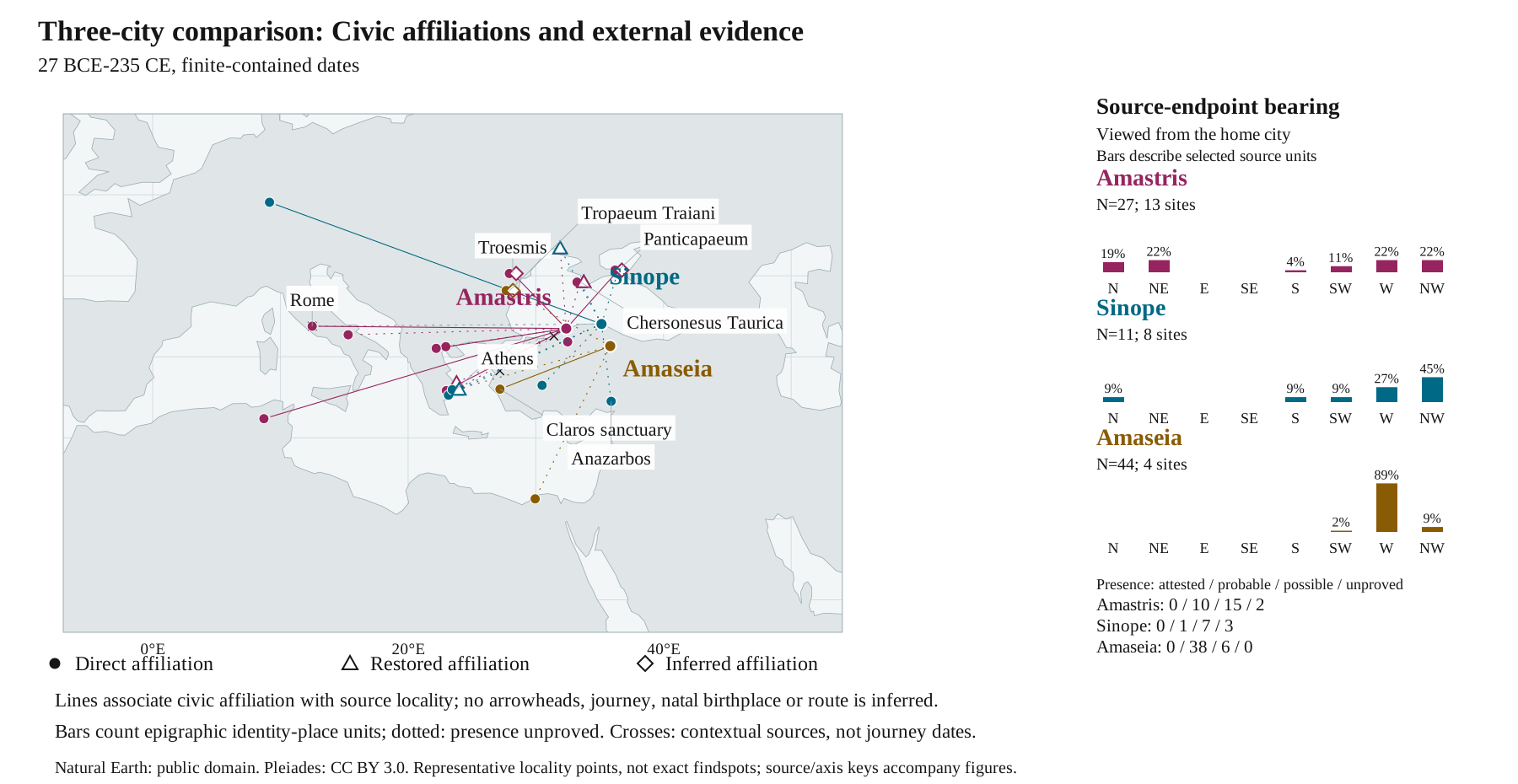
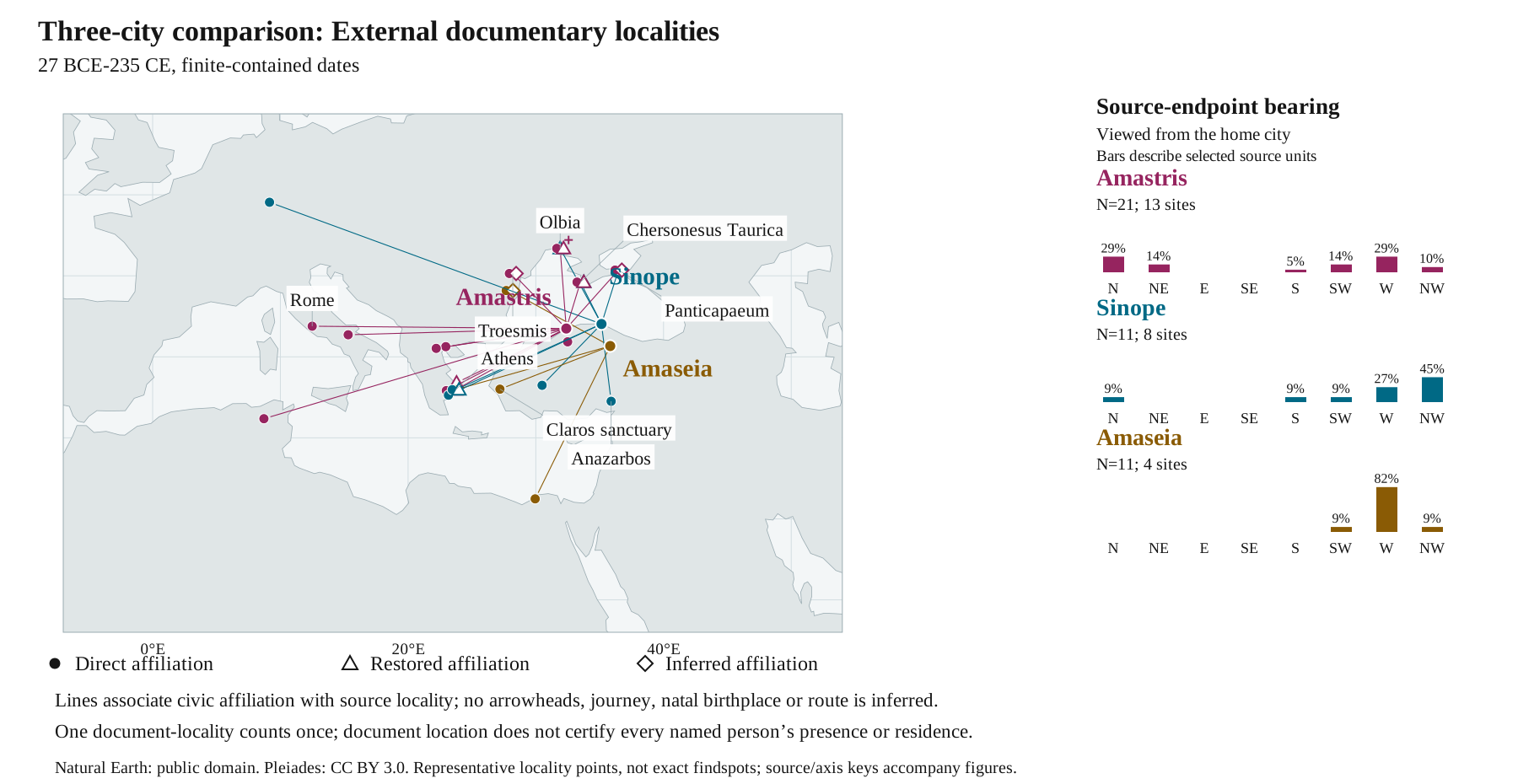
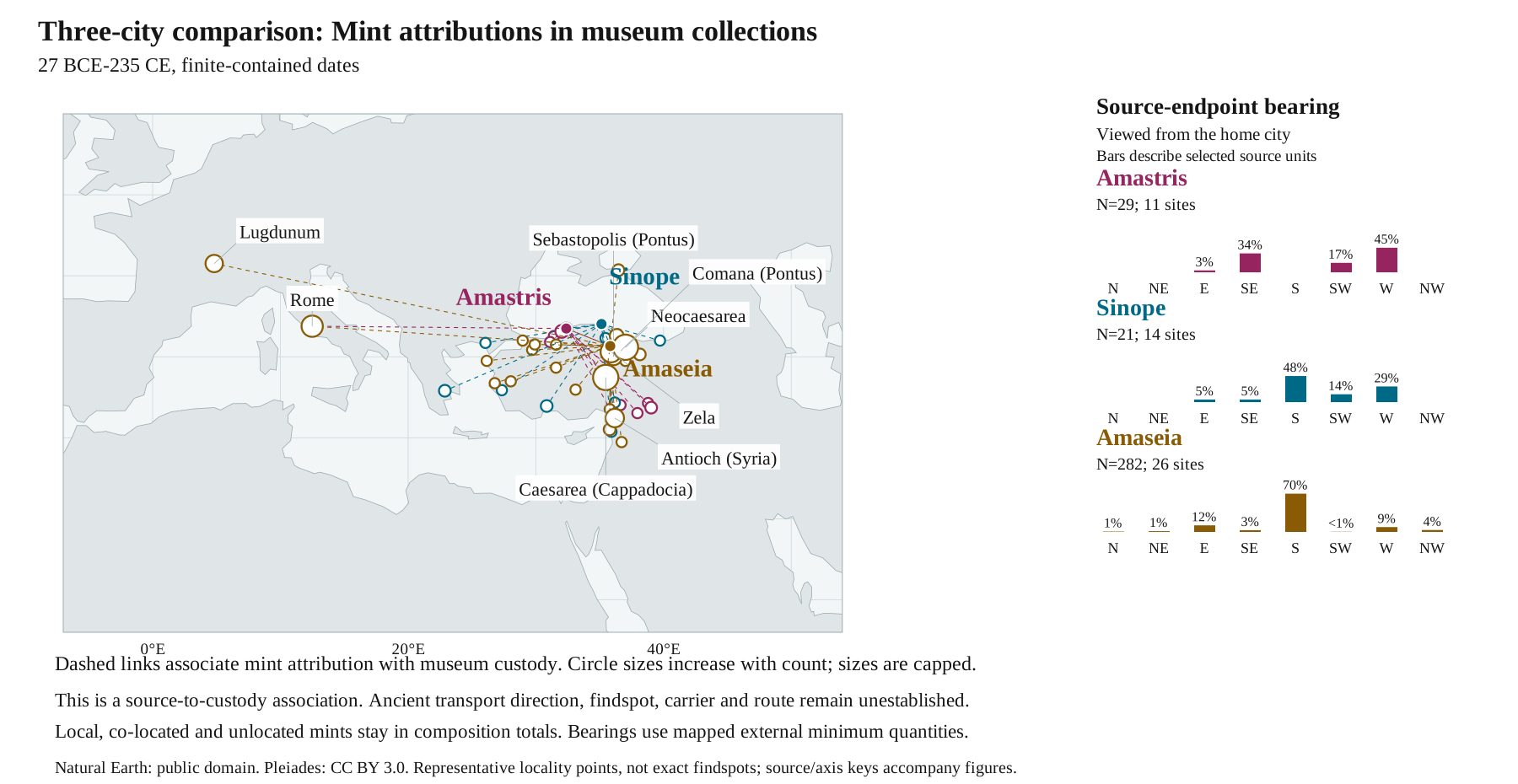
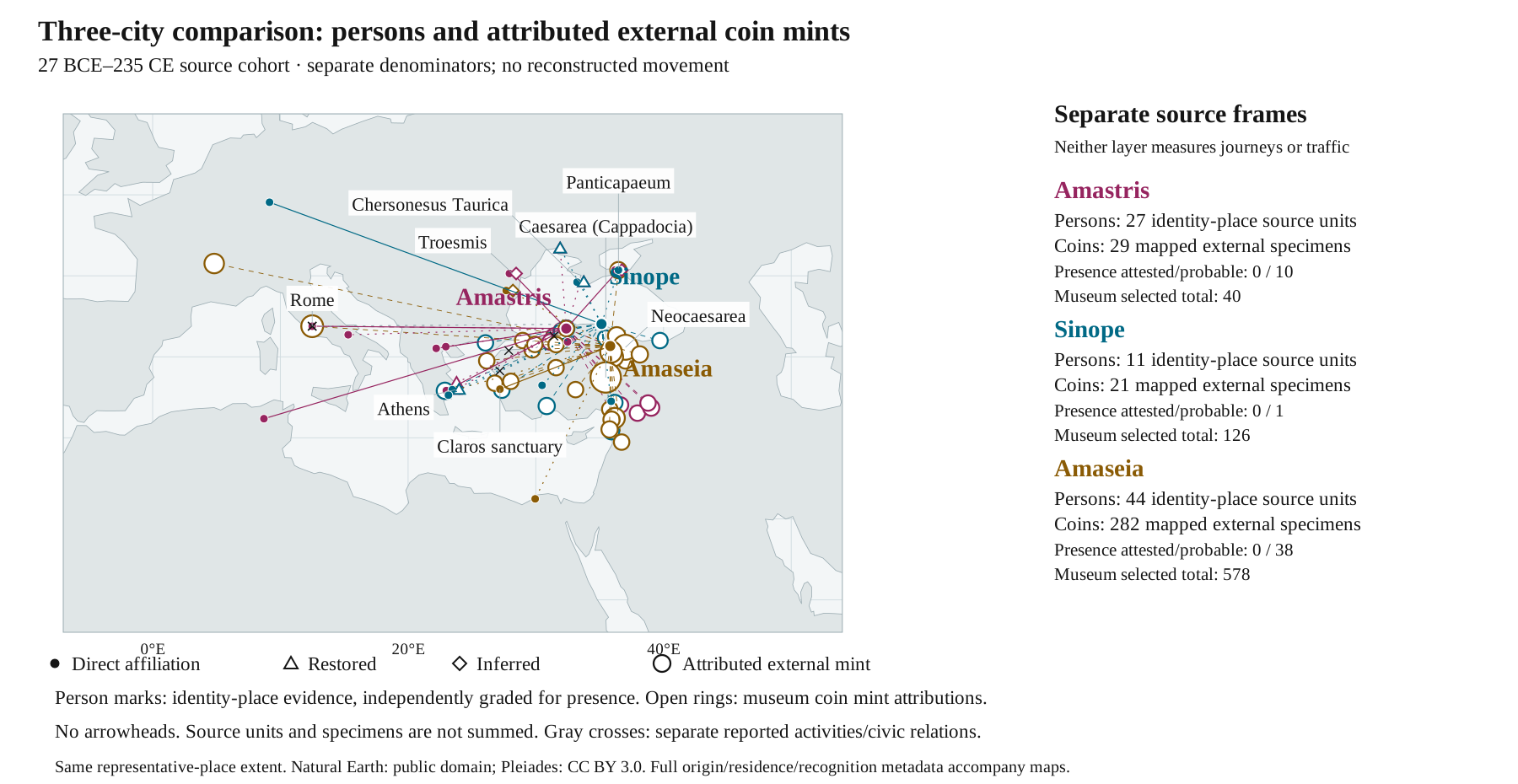
Read Amastris beside Sinope and Amaseia through three distinct records: people associated with a city, inscriptions recorded elsewhere, and mints represented in museum collections. Change the unit and the evidential threshold to see what supports a pattern.
A relation is the starting point. A civic label does not by itself establish presence, residence or intent. A mint identifies production; a museum identifies later custody. The lines below join these recorded associations without reconstructing an itinerary.
Why Ancient Ecology? The atlas asks how landscapes, infrastructure, institutions and material circulation relate. Environmental explanations remain questions to test against dated and independently contextualized evidence.
Loading the audited registers…
01 / Compare the records
Change the lens.
Common frame: 27 BCE–235 CE. Dates describe documents or issues, not arrival.
Representative city anchors; no exact findspot or workshop is asserted. Basemap: Natural Earth, modern land outline for orientation. Public-domain map data.
Which directions dominate the surviving record?
Locality concentration
Each city's share uses its own selected mapped denominator. These are recording concentrations, not shares of all ancient movement.
Published numbered catalogues. Not present-day museum inventories.
Does the proposed division into one-third local, one-third other city-associated and one-third Roman imperial coinage hold when period and metal are matched? Keep other issuing systems and unresolved classifications visible before considering a conditional three-part share.
Six exhaustive classification categories, specimen quantities
Museum frame
N
Local city
Other city
Roman imperial
Byzantine / later
Other systems
Unresolved
The three-part percentages exclude Byzantine/later, other systems and unresolved classifications, and therefore have a smaller denominator. “Other city” is a city-associated issue category; it is not synonymous with every external mint. A royal coin struck in a known city retains its royal regime. Cross-boundary and undated issues remain selectable bins. Main catalogues and separately published hoards are not pooled.
Inspect the complete coin ledger and source sections
The downloadable ledger retains main/hoard cohort, date range, reported metal, category, query and exclusion fields. Counts are quantities of specimens, not mint varieties, traffic, or value. An unlocated imperial mint can still be classified as imperial.
These profiles retain differing evidential grades and reasons. A row can describe an actor, an anonymous collective, a contextual person or a source outside the external-map selection. Search results do not automatically enter the map denominator.
Avram locators refer to the supplied November 2009 author typescript. They are not certified final 2013 pagination. Register dependence and bounded rechecks are retained; this interface does not imply a new edition or autopsy of every text. No detached Greek or Latin quotation is substituted for source context.
04 / Methodological challenges
What would change the interpretation?
The unit changes the pattern
A single list can supply many named actors. Person–place units and document–locality groups describe different things and share their source base. They must never be added as independent migrations. The Claros comparison can be tested above by switching layers and omitting the locality.
Unknown remains unknown
Affiliation, presence, activity, residence, settlement, living return, remains return and recognition have independent grades. Honorary citizenship need not imply a journey; funerary commemoration may be cenotaphic. Feelings of belonging and motives require their own evidence.
Collection histories matter
Mint, circulation, deposition, discovery and museum acquisition belong to different stages. Date and metal controls describe the catalogue but cannot recover missing provenance. Hoard and purchase histories remain a priority for explaining similarities and contrasts.
Landscape is a test, not an answer
Relief and coastal access suggest possibilities. Dated roadcuts, changing shorelines, river conditions, seasonal costs and survey coverage are needed before identifying causes. A fine analytical grid does not improve the resolution or chronology of its coarser source maps.
Scope decisions and uncertainties
Regional, ambiguous, local-report and literary relations outside the mapped comparison remain in the register or prior source dossier. An absent point means no eligible representative external point in this selection, not no connection.
Research by Ching-yuan Wu; atlas assembled from the audited Following Lucian registers and published catalogues. Ancient Ecology is the collection attribution. New methodological comparators and already-engaged scholarship are labelled separately below.
Audited figures for a static comparison
27 BCE–235 CE. The three evidence layers use different counting units; figures preserve their own denominators and limits.
Person–place associations.Document–locality associations.Attributed external mints.People and coin production localities, with distinct symbols.
Download the nine audited KMZ layers
One file per city and evidence family. Initial visibility, period windows, exclusions and uncertainty folders are retained. These are the audited files, unchanged.