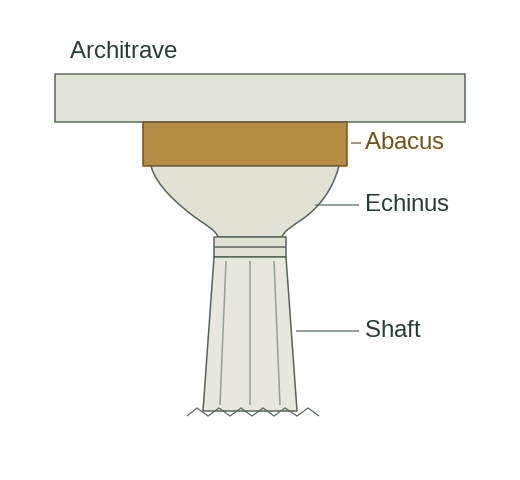
The abacus is the uppermost member of a column’s capital, immediately below the architrave.
In a Doric capital, its square slab rests above the curved moulding called the echinus. The highlighted slab in the diagram shows this architectural sense of the word.
Its form varies with the order. Vitruvius describes the Corinthian abacus with sides curved inward between the corners, and sets its thickness at one seventh of the capital’s height. This ratio belongs to his prescription for a Corinthian capital.
The same word also names objects such as counting boards, game boards and display tables in ancient texts. Identifying an architectural abacus therefore requires the context of a capital or column.
Original Magalia schematic; not a measured monument. Image source
James Yates, Abacus. London: John Murray, 1875; §1, §§4–6 Source
Philip Smith, Columna. London: John Murray, 1875; Doric order Source
Vitruvius, De architectura. Valentin Rose, Leipzig: B. G. Teubner, 1899; 4.1.11 Source
Identify the sense from the evidence 据证据辨析词义
Use the action or measurement in the source to decide which sense of acetabulum is in play. The same spelling can lead to different kinds of evidence.
Der Gebrauch oder die Maßangabe im Beleg hilft, die Bedeutung von acetabulum zu bestimmen. Hinter derselben Schreibung stehen verschiedene Arten von Zeugnissen.
可从原文所述动作或量值辨析 acetabulum 的含义。同一拼写可能对应不同类型的证据。
Acetabulum §1Serving or handling a cupServieren oder einen Becher handhaben取醋或使用杯子
Acetabulum §2Describing the shape of a hollowDie Form einer Vertiefung beschreiben描述凹穴的形态
Acetabulum §3Measuring a quantityEine Menge abmessen计量容量
Acetabulum §4Striking a vessel to make a soundEin Gefäß zum Klingen anschlagen敲击器皿取声
Acetabulum §1 醋器与戏法师的杯子
Pauly–Wissowa · Friedrich Hultsch · RE I,1, cols. 155
English
Vinegar vessel and conjuror’s cup
At the Roman table, an acetabulum could be a vessel from which diners took vinegar. Hultsch pairs Isidore’s account of its use with Ulpian’s inventory of silver utensils, then follows the wider word for a cup into Quintilian and Seneca.
In Seneca’s comparison with conjurors, cups and small objects hold the spectator’s attention. The literary example attests a use of the name. An archaeological identification also needs evidence of the object’s context or use.
Deutsch
Essiggefäß und Becher der Taschenspieler
An der römischen Tafel konnte das acetabulum ein Gefäß sein, aus dem die Gäste Essig nahmen. Hultsch verbindet Isidors Funktionsbeschreibung mit Ulpians Verzeichnis von Silbergeschirr und verfolgt den weiteren Bechergebrauch bei Quintilian und Seneca.
In Senecas Vergleich mit Taschenspielern fesseln Becher und kleine Gegenstände die Aufmerksamkeit der Zuschauer. Die literarische Stelle belegt einen Wortgebrauch. Zur archäologischen Bestimmung eines Gefäßes braucht man auch Hinweise auf Fundkontext oder Gebrauch.
Pauly–Wissowa · Friedrich Hultsch · RE I,1, cols. 155
English
Cup-shaped hollows
Hultsch gathers Pliny’s uses of acetabulum around the shape of a small vessel. Reading the checked passages together shows how the comparison changes. At 18.245 the singular acetabuli with modo supplies a likeness for budding fig leaves. At 21.92 the plural acetabulis names cup-like parts of a nettle flower.
At 26.58 the hollows of a root are compared with octopus arms. At 28.179 the same noun names hip sockets. The four citations show how Pliny can use the vessel analogy or apply the word directly to a hollow. The checked text is Detlefsen’s printed edition, which leaves Hultsch’s source edition open.
Deutsch
Becherförmige Vertiefungen
Hultsch ordnet Plinius’ Belege für acetabulum um die Form eines kleinen Gefäßes. Die geprüften Stellen lassen verschiedene Verwendungen erkennen. In 18,245 liefert der Singular acetabuli bei modo den Vergleich für austreibende Feigenblätter. In 21,92 bezeichnet der Plural acetabulis becherförmige Teile der Nesselblüte.
In 26,58 werden die Höhlungen einer Wurzel mit den Armen von Kraken verglichen. In 28,179 bezeichnet dasselbe Substantiv die Hüftpfannen. An diesen Stellen lässt sich unterscheiden, wo Plinius ein Gefäß als Vergleich heranzieht und wo er eine Vertiefung unmittelbar benennt. Die Prüfung beruht auf Detlefsens Druckausgabe. Hultschs benutzte Ausgabe bleibt offen.
Pliny the Elder, Naturalis historia 26.58, ed. Detlef Detlefsen, vol. IV, Libri XXIII–XXXI (Berlin, Weidmann, 1871), p. 117, lines 29–30 and p. 118, line 1.
item ossa ex acetabulis pernarum circa quae coxendices vertuntur.
Pliny the Elder, Naturalis historia 28.179, ed. Detlef Detlefsen, vol. IV, Libri XXIII–XXXI (Berlin, Weidmann, 1871), p. 204, lines 5–6. Section 179 begins on p. 203, line 34.
Pauly–Wissowa · Friedrich Hultsch · RE I,1, cols. 155–156
English
Roman measure of capacity
As a Roman capacity unit for dry and liquid goods, one acetabulum equals a quarter of a hemina or an eighth of a sextarius. Hultsch renders it as about 68 mL. He also gives a reckoning of two and a half Roman ounces for the wine filling the measure.
The fractions express capacity. The ounces refer to his reckoning of the mass of wine. Use those distinctions when a recipe supplies a unit but the object record supplies a drawing or a capacity measurement.
Deutsch
Römisches Hohlmaß
Als römisches Maß für trockene Stoffe und Flüssigkeiten entspricht ein acetabulum einem Viertel einer hemina oder einem Achtel eines sextarius. Hultsch setzt rund 68 Milliliter an. Für die Weinfüllung nennt er auch eine Rechnung mit zweieinhalb römischen Unzen.
Die Bruchteile bezeichnen ein Volumen. Die Unzen gehören zur Gewichtsrechnung der Weinfüllung. Diese Unterscheidung hilft beim Vergleich von Rezeptangaben mit Gefäßzeichnungen und gemessenen Fassungsvermögen.
Ernst Graf treats the vessels as sound-producing objects. His source dossier includes earthenware and copper-alloy vessels, with silver examples in Cassiodorus. Boethius describes vessels of differing weights sounded with a rod and connects them with the tradition of Pythagoras’s experiments.
Read the apparatus as a collection of testimonies about materials, playing and harmonic comparison. Graf reports an attribution to a comic poet called Diocles. The sources leave the identification and the instrument’s exact physical arrangement open.
Deutsch
Angeschlagene Gefäße
Ernst Graf behandelt die Gefäße als Klangkörper. Seine Belege betreffen Ton- und Bronzegefäße sowie bei Cassiodor auch silberne Stücke. Boethius schildert mit einem Stab angeschlagene Gefäße unterschiedlichen Gewichts im Zusammenhang mit der Überlieferung zu Versuchen des Pythagoras.
Der Quellenapparat versammelt Zeugnisse zu Material, Spielweise und harmonischem Vergleich. Graf referiert die Zuschreibung an einen Komödiendichter namens Diokles. Die Identifizierung und die genaue Anordnung des Instruments bleiben offen.
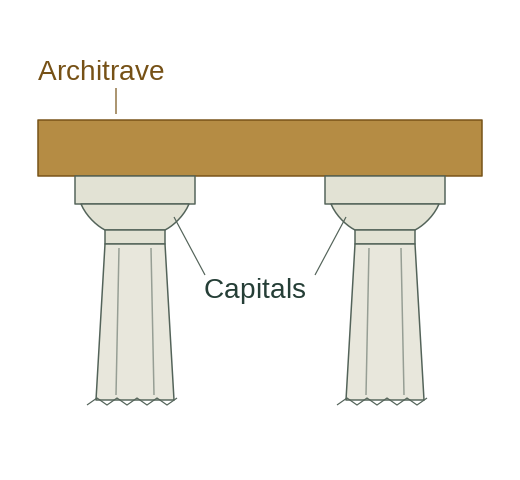
The architrave is the lowest member of an entablature, carried immediately above the columns. In this architectural sense, Latin epistylium names the horizontal member above the capitals.
Its front is generally plain in the Doric order. In the Ionic and Corinthian orders it commonly has two or three stepped horizontal bands, called fasciae. Smith also records broader use of epistylium for the entire entablature, so a cited passage must be read in context.
item epistylii latitudo ima respondeat hypotrachelio summae columnae.
English
Likewise, let the lower width of the architrave correspond to the necking at the top of the column.
简体中文
同样,额枋底部的宽度应与柱子顶端的柱颈相应。
Sources & attribution
Original reference entry; sources listed below.
Valentin Rose, Leipzig: B. G. Teubner, 1899, as transcribed on LacusCurtius · 4.3.4 · Complete sentence beginning item epistylii and ending summae columnae
Original Magalia schematic; not a measured monument. Image source
Philip Smith, Epistylium. William Smith (ed.), A Dictionary of Greek and Roman Antiquities, London: John Murray, 1875, p. 469; Definition, order-specific forms, and final sentence on broader usage Source
Vitruvius, De architectura. Valentin Rose, Leipzig: B. G. Teubner, 1899, as transcribed on LacusCurtius; 4.3.4 Source
Echinus 柱头曲面线脚
Magalia reference entry · Magalia
English
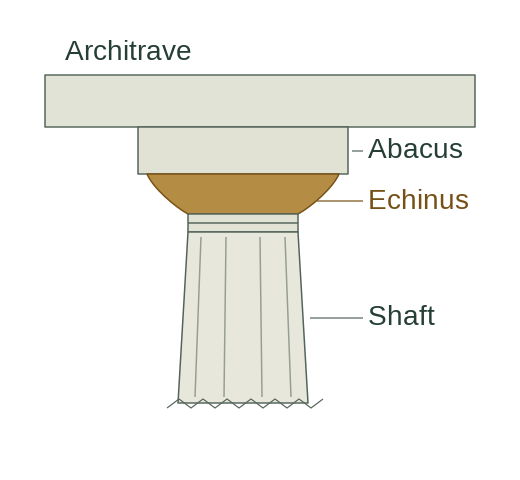
The echinus is the curved moulding beneath the abacus in a Doric capital. It spreads outward above the shaft to receive the square slab.
Vitruvius groups the echinus and its rings within his division of a Doric capital.
crassitudo capituli dividatur in partes tres, e quibus una plinthus cum cymatio fiat, altera echinus cum anulis, tertia hypotrachelion.
English
Let the height of the capital be divided into three parts: one to form the plinth with its cymatium, another the echinus with its rings, and the third the necking.
Valentin Rose, Leipzig: B. G. Teubner, 1899, as transcribed on LacusCurtius · 4.3.4 · Complete sentence beginning crassitudo capituli and ending tertia hypotrachelion
Original Magalia schematic; not a measured monument. Image source
Philip Smith, Columna. William Smith (ed.), A Dictionary of Greek and Roman Antiquities, London: John Murray, 1875, pp. 323–328; p. 325, I. The Doric Order Source
Vitruvius, De architectura. Valentin Rose, Leipzig: B. G. Teubner, 1899, as transcribed on LacusCurtius; 4.3.4 Source