What was checked
The preceding dossier audited 35 claims against excavation publications, specialist scholarship and institutional reports. This presentation preserves their distinctions while adding visual explanations.
Download the claim ledger ↓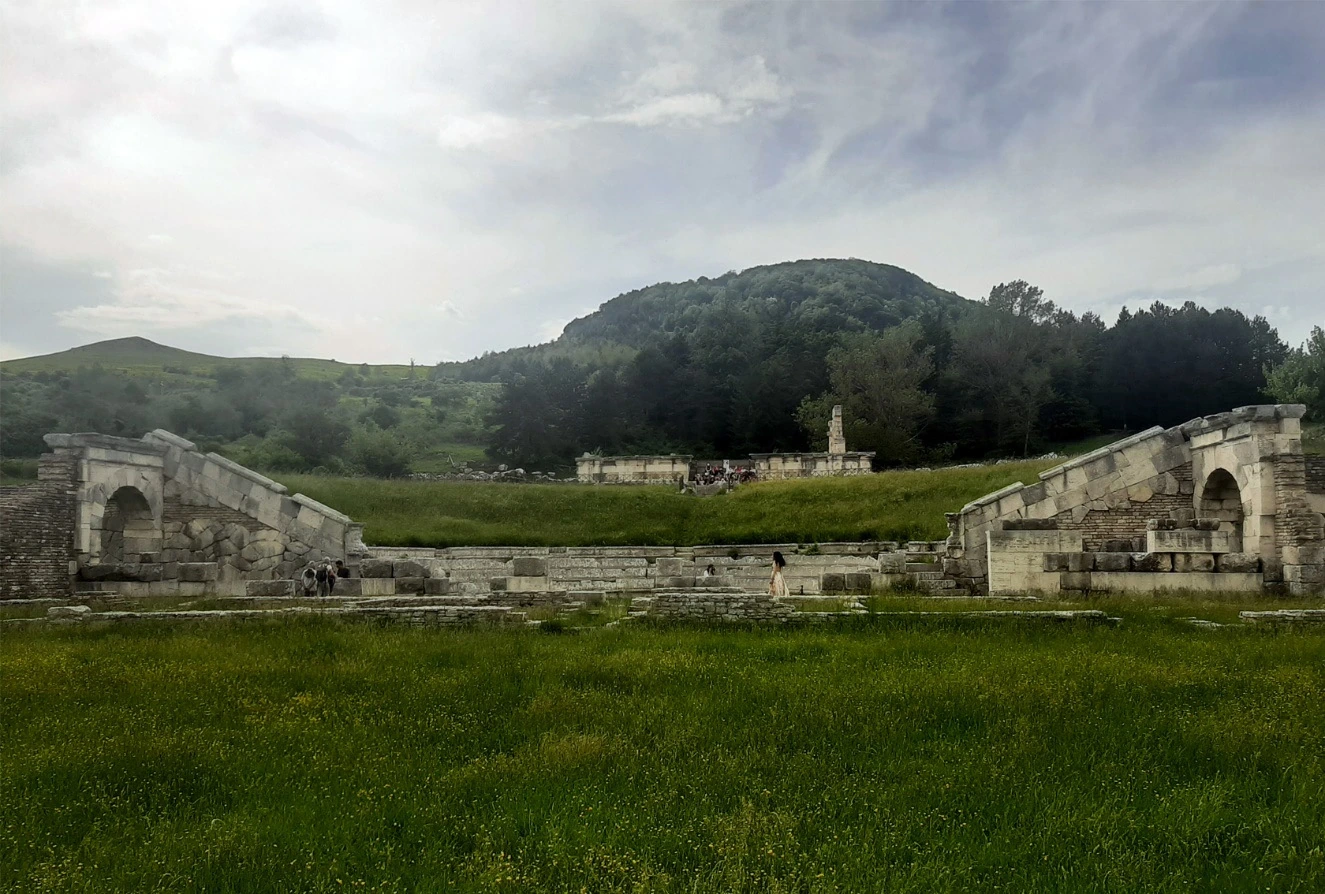
CALCATELLO · MOLISE · ITALY
A sanctuary through time
Read the architecture of gathering in Samnite Italy.
Explore the phases, then inspect the evidence for each interpretation.
Photograph by A. Marra, G. Fabbrocino & S. Fabbrocino · 2022, fig. 5 · CC BY 4.0
ARCHAEOLOGY IN SEQUENCE
Choose a phase to change the reading focus.
Buildings are not assumed to appear or disappear together.
Architectural reading model
A schematic spatial explanation, informed by the published plans. Heights, roofs and terrain are illustrative. Colour marks the selected discussion; pale buildings are not evidence of absence or abandonment.
LOOK CLOSELY
Authentic photographs lead back to individual features.
QUESTIONS WORTH KEEPING OPEN
THE PUBLISHED RECORD
Zoom the original schematic model and select a feature.
Then inspect the cited published drawing on its source website.
Select labelled model features or use the buttons below. Geometry, terraces and heights are illustrative; no source-plan coordinates are transferred into this drawing. Contrast affects only this display.
The public viewer uses the original schematic drawing with pan, zoom, feature selection and display contrast. Five published-plan rasters are withheld because open republication rights were not established. Follow each source link for the actual plan, its scale, orientation and conventions. The general plan retains question marks in the publication; the Temple B star marks secondary inscription reuse. Neither source-plan pixels nor coordinates are reproduced by this explanatory model. Publication or drawing dates are not ancient dates.
PLACES IN RELATION
Regional context and architectural comparison are different relations.
A point or a connecting line is never evidence of a journey.
Modern physical context, not ancient frontiers or shorelines. Natural Earth land via Magalia Ancient Ecology World. Leaflet © contributors.
COMPARE A QUESTION
A similar shape can serve different institutions.
Choose a question before drawing an analogy.

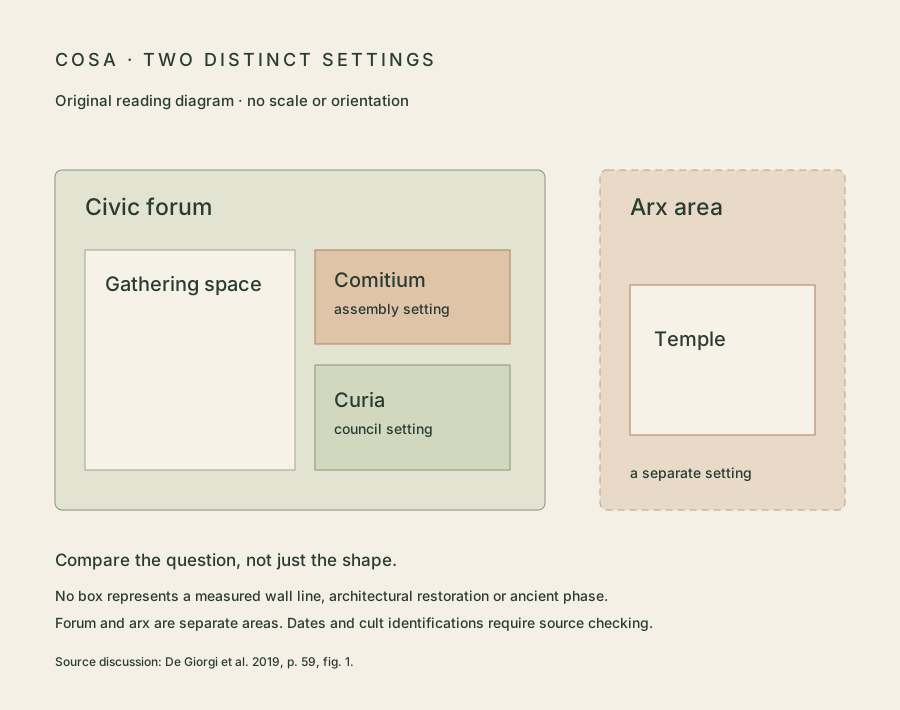
Figures are independently fitted to their frames. They do not share a display scale. Rome’s image is an explicitly later reconstruction; it is never presented as excavated fabric.
| Site | Use the comparison to ask | Keep this distinction |
|---|---|---|
| Pietrabbondante | How did a sanctuary organize several kinds of gathering? | Theatre, altar area, portico and residence have different thresholds. |
| Cosa | How does a gathering enclosure relate to a council building? | The forum and arx temple are separate; dates and cult labels are debated. |
| Republican Rome | How do audience, speaker and council occupy changing spaces? | Name the phase. A circular Comitium is a reconstruction question. |
| Gabii and Tivoli | How does an elevated temple relate to a theatre and court? | Formal parallels do not establish identical political procedures. |
RESEARCH EDITION · 19 OCTOBER 2026
Source access, dating and restoration remain visible.
Uncertainty is part of the reading, not a hidden footnote.
The preceding dossier audited 35 claims against excavation publications, specialist scholarship and institutional reports. This presentation preserves their distinctions while adding visual explanations.
Download the claim ledger ↓The complete 2022 and 2024 excavation volumes were not read in full. Contents, abstracts and indexed passages are labelled as such. No interactive reconstruction supplies missing stratigraphic evidence.
Download the full source register ↓Photographs show surviving and restored remains. Embedded Rome imagery is an attributed CC BY 4.0 historical reconstruction crop. Original diagrams explain relationships. Five reserved or unverified plan rasters are linked to their publications instead of embedded.
Ancient Ecology World informed the separation of source identity, location and claim, local physical basemaps, figure comparison and research-note export. Amastris informed the reading of different evidence layers without converting them into travel. Roman Figlinae informed explicit relation types and the distinction between a place’s location and the interpretation attached to it. The public edition preserves those methods without treating any earlier local QA receipt as publication evidence.
Explore the Ancient Ecology catalogue ↗