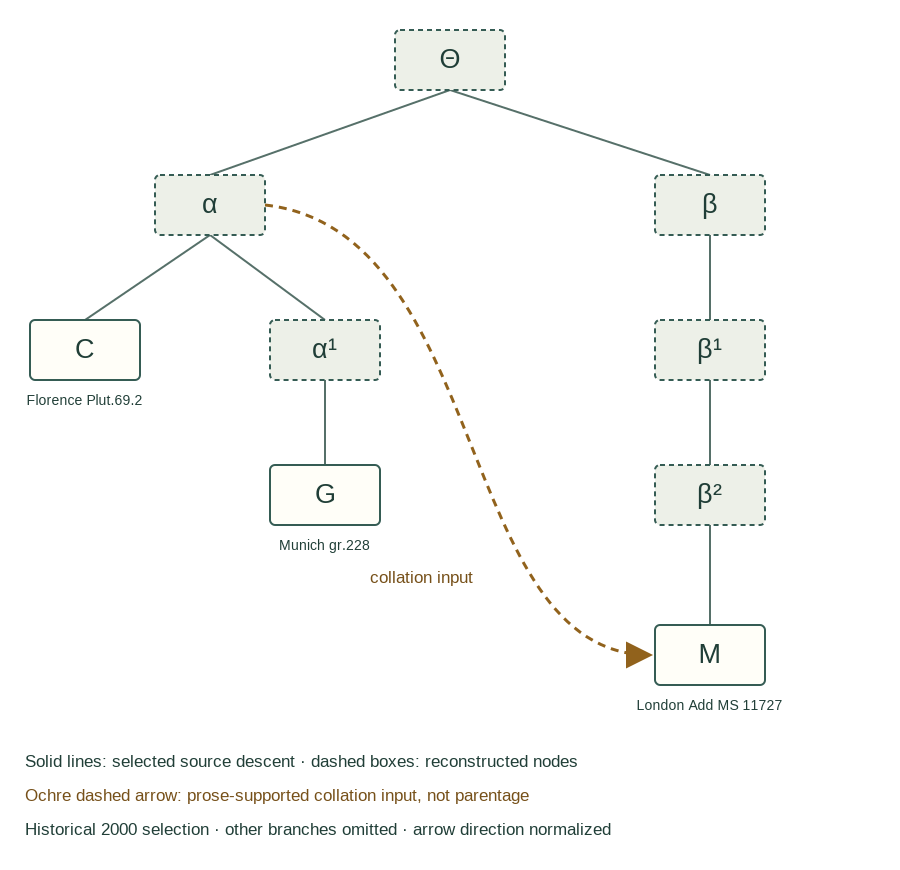
Alberti’s later prefaces change parts of his transmission argument. Read the 1972 selection alongside the 1992 and 2000 evidence, with descent and collation input kept separate.
Volume III edits Books VI–VIII; the preface also revisits evidence from other books. Figure p.XIX supplies the selected descent paths; pp.XVII–XVIII explain M’s proposed use of α. This does not establish uniform affiliations throughout all eight books.
Eight solid lines follow selected descent paths in the 2000 source figure. The ochre dashed arrow is a separate prose-supported collation input from α to M; its direction is normalized for this guide. Dashed boxes are reconstructed nodes. Click a physical witness for its card; reconstructed nodes have no repository links.
Alberti retracts his earlier resistance to explaining M through consultation of α and now argues that M used that subarchetype. This is a collation input alongside M’s descent path, not a new physical parent.
The earlier position at vol.I, p.LIII n.1 is reported here through Alberti’s 2000 self-correction; that 1972 passage was not freshly inspected.
editorial selection policy
A selective apparatus
Vol.II(1992), pp.XIV–XV
For this volume Alberti says G is cited almost always, apart from manifest errors; Pl and Ud are cited when they agree with C alone. Apparatus reporting therefore follows an explicit selection policy.
An absent siglum cannot automatically be counted as agreement or silence of the manuscript. These policies do not establish fresh readings or a whole-work genealogy.
Alberti 1992 considers identifying Λ with Ξ highly plausible. The 2000 figure labels Λ(=Ξ?) and Φ(=Ω?), retaining question marks. Those possible equivalences are not merged into physical manuscripts.
These ancient exemplars and their proposed equivalences are omitted from the small C/G/M graph. A question mark is not confirmation.
explicit editorial revision
A withdrawn reconstruction
Vol.II(1992), p.XII; vol.III(2000), pp.XX–XXI
The 1992 preface proposes an edition connected with the imperial library under Constantius II. In 2000 Alberti no longer defends that account and leaves the broader question uncertain.
This is an account of an editor’s changing reconstruction, not an established late-antique publication event.
primary extract comparison
Dover’s working hypothesis
Dover 1954, publisher Extract, observation2
Dover’s own extract places ABEFHM under β but excludes C from β. He treats G’s independence from C as undecidable after contamination and adopts descent from C as an economical working hypothesis.
The extract does not verify the full diagram or justify adding a new C→G edge to Alberti’s models.
source dating comparison
Three dates for Heidelberg E
Alberti 1972, p.XII; Alberti 2000, p.XXIII; Heidelberg manifest checked 5 November 2026 in cycle14
The same E is dated to the end of the tenth or beginning of the eleventh century in the 1972 inventory, the beginning of the tenth century in the 2000 sigla, and the end of the ninth century in Heidelberg’s manifest.
All three source datings are retained. No independent palaeographical adjudication or fresh manifest fetch in this cycle.
research lead
A later stemma awaits inspection
Prometheus 36.1 (2010), issue and abstract; site posting2012-10-03
A later Alberti article explicitly advertises another updated stemma. The 2000 model must therefore retain its date and cannot be presented as the author’s final or a current consensus model.
The 2010 figure and the earlier 2007 article remain uninspected.
Physical manuscripts and access limits
M adds a checked holding-library catalogue route, not a claim of accessible digitization. C keeps its existing admitted identity; G keeps its edition identity. A correction or supplement hand is not a separate codex.
Catalogue checked 5 November 2026. The library reports digital images unavailable. No image viewer, current manuscript pixels or complete download verified. The library describes an eleventh-century codex with later replacement leaves. M and its correction or supplement labels must remain distinct; no physical descendant is inferred from a hand siglum.
G.B. Alberti, Altre note di un vecchio tucidideo, Prometheus 36.1 (2010)
bibliography verified · Journal issue, abstract and online publication metadata
Abstract reports an updated stemma following a 2007 article. Article text and figure not inspected. The 2012 posting date is not substituted for the 2010 issue year.
Printed edition dates are 1992 and 2000; a preface’s signing date is not substituted for its volume’s publication date. The later article belongs to the 2010 issue; the site records a 2012 posting. Its text and figure have not been inspected.